

Still detectable: inside StrikePlagiarism.com’s Claude Fable 5 test results



For universities, the concern was immediate: if a model can write convincingly across disciplines, in a natural academic register, does detectability still hold?
Early results show that it does.
How StrikePlagiarism responds to Claude Fable 5
The release of Claude Fable 5 reinforced a broader challenge facing higher education: AI development now outpaces institutional policy cycles. For StrikePlagiarism, this moment required immediate empirical validation rather than theoretical assumptions.
Within days of Claude Fable 5 entering academic use, StrikePlagiarism.com analysed hundreds of academic documents generated by the model — research papers, essays, literature reviews and coursework spanning sociology, economics, computer science and education, ranging from roughly 1,000 to over 5,000 words each. The results were unambiguous:
- The majority of documents scored in the 81–100% AI-probability range
- Many reached an AI Content Indicator of 100%, with individual fragments exceeding 95% AI probability
- Longer academic papers produced particularly stable detection results
Rather than relying on surface-level markers, StrikePlagiarism.com analysed each document in full, returning fragment-level probability scores instead of a single verdict. One representative sociology paper illustrates the pattern below: a 100% AI Content Indicator, with a 2,415-word fragment scoring 99% AI probability.
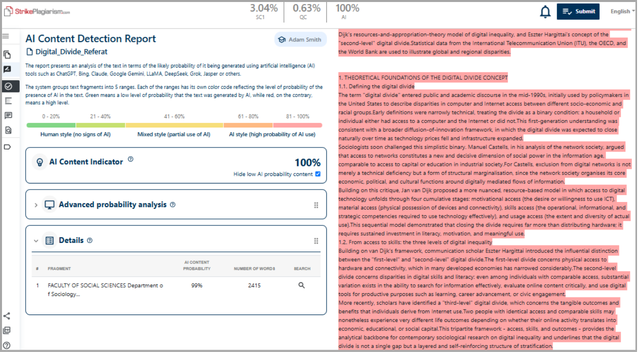
A StrikePlagiarism.com AI Content Detection report for a Claude Fable 5-generated academic paper.
Why Claude Fable 5 remains detectable
Claude Fable 5 demonstrates strong command of academic register and avoids the obvious repetition seen in earlier models. However, across the evaluated documents, analysis consistently revealed:
- unusually consistent sentence rhythm,
- highly uniform academic register across sections,
- predictable paragraph development and repetitive transitions between arguments.
Individually, these signals are subtle. Taken together, they form a measurable behavioural profile. Detection no longer depends on awkward phrasing or stylistic errors — fluency improves, invisibility does not.
Core advantages of StrikePlagiarism.com’s AI detection approach
StrikePlagiarism.com was designed to support institutions operating at scale, across disciplines and document types:
- Fragment-level analysis, not a single score - Reports break down AI probability by section, showing educators exactly where signals appear rather than returning one number to interpret blindly.
- Stability across document length Detection results remained consistent even in longer academic papers exceeding 5,000 words.
- Built for real academic review Every report is designed to support, not replace, expert judgement — giving reviewers evidence they can defend.
Why AI detection is critical right now
Claude Fable 5 makes one reality clear: the primary risk for universities is no longer obvious AI misuse, but large volumes of academically convincing AI-generated work entering assessment unnoticed. This is not a future concern — it is a present operational challenge.
StrikePlagiarism addresses this challenge at an institutional level. By combining fragment-level AI behaviour analysis with transparent, probability-based reporting, StrikePlagiarism.com enables universities to respond now, not retrospectively. As language models continue to improve, robust, evidence-based AI detection remains essential infrastructure for academic integrity — not an optional safeguard.
StrikePlagiarism.com → Real detection. Real integrity.
